Liberation and Lavender Linguistics

Introduction
On August 15th, 2021, transgender activist Grace Banu was awarded ‘Best Third Gender’ by the Government of Tamil Nadu. She was honored for her contributions to her community and the society at large, but the ceremony included a telling incident. She protested on stage with the higher officials while receiving the award for the use of the term ‘third gender’ in it, and this was an assertion by her that the transgender community needs to be addressed on our own terms.
In 2006, the usage of the word “thirunangai” was born in official records, a term introduced by dancer-scholar Narthaki Nataraj, and subsequently popularized by former Chief Minister Kalaignar M. Karunanidhi, which was welcomed by several trans women and the society at large. The previous word in usage was ‘aravani,’ , which had been offered as a non-pejorative term in 1997 by Mr. Ravi, then District Superintendent of Police of Villupuram, the district where the Aravan temple, site of an annual community festival, is located. The replacement of ‘aravani’ by ‘thirunangai’ could perhaps be attributed to the respect accorded by the community to Kalaignar, and to the dignity associated with the term nangai.
Fast forward to 2019: the then government issued a press release to replace “thirunangai” with “third gender”—or “moondram paalinathavar” (belonging to the third gender). This was largely to dissociate from the word ‘thirunangai’ associated with the previous Chief Minister, who was from a rival political party. The word for the Transgender Welfare Board, the first of its kind in the country, had also been changed to reflect the Third Gender Welfare Board. This made several transgender activists wonder about who the first and second genders were in this hierarchical and inherently patriarchal language usage, and what the ranking system would be for the inclusion of further gender categories in the official parlance.
The current controversies around the Tamil Nadu Welfare Board being renamed “Thirunangai Nala Vaariyam” and recently released policy being named “Thirunangai Kolgai” to the exclusion of Thirunambis (trans men) and Idai-paalinatthavar (intersex persons) illustrate that evolution of defining inclusive and dignified terms for the transgender community is the one embroiled in political and social conflicts. This also provides us a prime example of how language is a stellar medium for queer expression and the need for us in the community to reclaim and democratize this process.
Lavender linguistics
Lavender linguistics, or queer linguistics, is the use of language practices, both spoken and written, to encompass a wide range of the LGBTIQ+ communities. This involves everything from the nuances to the ways we express our identities within the community and the larger society and vice versa, as the language the larger population uses for us also impacts our expression in several contexts. For example, multiple studies have indicated that male American English speakers are recognized as gay by their speech at rates above chance which could be attributed to what is popularly known as ‘a gay lisp’: the articulation of /s/ and /z/ with a higher frequency and longer duration than average speakers.
Our pitch also plays a role between communities. Few studies say that among lesbians the use of lower pitch and more direct communication styles is found and there is also an increased usage of more backed variants of back vowels. These studies could also have their own faults, as several linguists argue that these analyses have been too simplistic and that these theories are constructed through the combination of sometimes-conflicting stylistic tropes. Nevertheless, we can ascribe from our daily experiences that our lexicons and phonetics impact our lived experiences and our expression.
Gender performativity
Adolescent males often perform their gender through language. Slur terms like ‘fag’ and ‘ombodhu’ used by peers to police gender boundaries. This reinforces the misogyny inherent in the assertion of masculinity by these adolescents.
We try to toe their gendered rules in our slang, pronunciation, and articulation. Our yearning for expressing our queer identities faces its first challenge here, and many of us are silenced. We rather learn as we age how to express ourselves, not only imbuing the existing vocabulary that helps us in expression but also creating new lexicons and grammar as we learn better self-expression.
To announce oneself as queer to another person for the very first time or to a room full of an audience is a liberation on its own, and this involves a two-way understanding of the language we use, how we perceive the term, and how the others do.
Language as queer performance
Queer people also use language as a performance, albeit in different ways. The stylistic innovative usage of terms (e.g., “slay,” “you go girl,” and “yaas queen”) among queer communities can be relatively higher. This form of usage can strengthen our bonds through shared language use. Slogans and chants (We’re here, we’re queer/Out and proud) have helped us organize ourselves politically. Our political language has evolved to include race, class, caste, and disability.
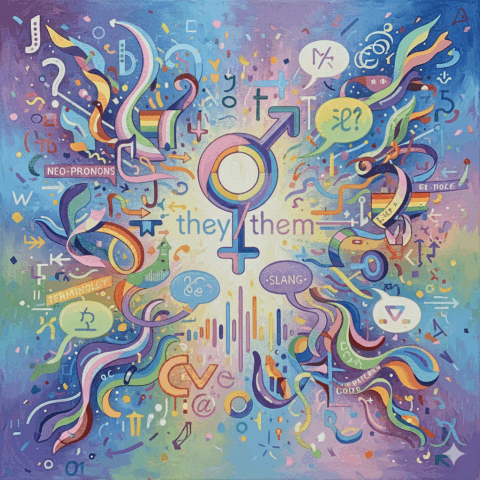
We are continuously forming new lexicons for better self-expression. We use our language to challenge the binaries surrounding us, from using “they/them” pronouns to challenge the norm of gendered pronouns to rejecting “husband” or “wife” in favor of “partner” or “spouse”, destabilizing heteronormative assumptions.
Code-switching
Code-switching is the act of switching languages or language styles within a sentence or conversation. Our choice of slang depends on who our audience is and also the context. We make our shift depending on our situational needs, such as the need to demonstrate or conceal our identity in a particular environment.
“Exploratory switching” is when we use our language slang or style to determine whether an interlocutor shares our identity. For example, a gay man might use certain keywords and mannerisms generally known by the community as a test to see whether they are recognized by the interlocutor. This allows the gay man to establish solidarity with a community member previously unknown to him without having to disclose his orientation to a heterosexual person and potentially hostile person.
A fine example would be the popular code word question ‘Are you a friend of Dorothy?’ used within Anglo-American gay male communities in the mid-twentieth century, with the equivalent being ‘friend of Meena Kumari/ Rekha/ Sridevi’ in the Indian gay male communities and their diasporic brethren in the 1990s and 2000s. Therefore, our community speech has a relationship with our community of practice. We may have a shared interest and respond to a mutual situation, and through communicating regularly, we may develop certain speech norms.
Our language also shows our other biases and reinforces them. Queer casteist people have developed such speech norms that uses casteist slurs are often prefixed or suffixed while describing marginalized queer people.
Conclusion
Lavender linguistics can also be subject to high generalization. Just because two individuals are both self-identified queer women does not necessarily mean that they must engage in the same linguistic patterns and social styles. We have our multiple social identities, and all these play a role in our language, and the purpose of this essay is to acknowledge the role of our queer identity in our language usage. It is imperative to understand this because our social identities are not static, speech styles are actively subject to change, and one’s speech styles have different social meanings across time.
We and the larger society still perform language in a non-inclusive manner, and this has to change. The fight should not just be against the slurs but also towards a more inclusive language that respects our personhood and provides a space of dignity in our and their lexicons. The Tamil glossary of LGBTQIA+ issued in the Tamil Nadu Government Gazette in 2022 is a prime example of how communities strive towards reclaiming language for ourselves by ourselves. The government might have reverted to the usage of ‘Thirunangai’ for transpeople again, but we have to strive for an inclusive ‘Thirunar.’
The way we talk is a part of identity formation, which is fluid and highly dynamic in nature. So, our languages should evolve accordingly, and we cannot do this without inclusivity.
Further reading
https://en.wikipedia.org/wiki/Gay_male_speech
https://www.newindianexpress.com/cities/chennai/2022/Mar/30/for-the-dawn-of-dignity-2435611.html
https://orinam.net/wp-content/uploads/2022/01/Glossary_LGBTIQA_Jan2022.pdf
https://en.wikipedia.org/wiki/LGBTQ_linguistics#cite_note-11
https://folklife.si.edu/talkstory/2016/are-you-a-friend-of-dorothy-folk-speech-of-the-lgbt-community
https://www.thequint.com/entertainment/celebrities/sridevi-remembered-by-queer-community-in-india
https://www.jgnt.co/rekha-bollywood-queer-icon
Image credits: Gemini AI.